
Can Anyone Be Fire Fighter
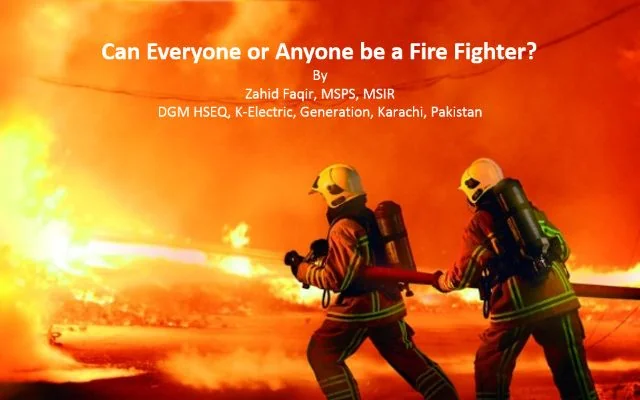
Most Entrepreneur’s and CEOs would hate me if I say everyone can not fight fire?
Specially in the developing world, most finance managers expect a few professional fire fighters in their fire squads.
They think all in the company should know fire fighting and they should be able to deal with the do.
For them if a safety manager talks about having exclusive team of fire fighters, he is himself of no use.
Its very painful, specially bearing the fact that we have lesser state owned Fire Fighting Back up squads and even those available are not adequately equipped.
Imagine a company sets up a plant worth 100 Million US Dollars or even more but they feel a Fire Water Network would do, as if by itself.
Fire is not a video game everyone will interest to learn and play. It can turn much more disastrous than we actually can imagine. Its much different and far more then just operating a Hose or using an extinguisher.
Fire Engineering is now a separate science and discipline in developed nations.
I also agree that multi tasking is very much in, these days but for assignments like crisis management and fire fighting we should never depend upon ordinary.
In my experience and I am surely confident about what I am trying to advocate. The Art of basic Fire Fighting and Fire Management should be taught to all in the organization but that should be the last layer of protection. Depending upon the potential fire Hazards and the size of the organization or plant we must grow a team of Professional and Committed fire Fighters.
Auxiliary fire fighters can help and would always be needed but Managements must understand fire fighting cannot be an alternate job.
Firefighting Is Not Simply About Holding an Extinguisher
When a fire occurs, many people believe that anyone can become a firefighter simply by picking up a fire extinguisher. In reality, responding safely to a fire requires knowledge, training and an understanding of the risks involved.
Every employee should have a basic awareness of fire safety. They should know how to raise the alarm, understand the emergency evacuation procedure and recognize the importance of leaving the area when conditions become dangerous. Employees may also be trained to use portable fire extinguishers for an appropriate and very small fire, but only when they have received proper training and when it is safe to do so.
A fire can develop much faster than people expect. Smoke, heat and toxic gases can quickly create life-threatening conditions. This is why no person should attempt to fight a fire when there is a significant risk to life, when the fire is spreading rapidly or when the available equipment is not suitable for the type of fire.
Different fires require different methods of control. Using the wrong extinguishing medium can make a situation worse. Employees therefore need to understand the basic types of fire, the limitations of available extinguishers and the circumstances in which evacuation is the safest option.
Organizations should also identify and train suitable employees to perform specific emergency roles. Fire wardens, emergency response teams and other designated personnel may have responsibilities such as assisting evacuation, checking assigned areas, guiding employees to assembly points and communicating important information to emergency services.
Professional firefighters, however, require a much higher level of competence. Their work may involve entering hazardous environments, using specialized equipment and making critical decisions under extreme conditions. This level of firefighting cannot be achieved through a short awareness session.
Training is therefore essential, but training should also be practical. Employees need opportunities to understand how emergency procedures work in real situations. Fire drills can help identify weaknesses in evacuation routes, communication systems, assembly arrangements and emergency responsibilities before an actual emergency occurs.
Equipment alone does not create fire safety. An organization may have extinguishers, alarms and emergency signs, but these measures are only effective when people know what to do and when to do it.
The first priority in any fire emergency must always be the protection of life. Property and equipment can be replaced; people cannot.
A strong fire safety programme should therefore focus on prevention first, early detection second, safe evacuation third and firefighting only when it can be undertaken by appropriately trained people under safe conditions.
The question is not whether anyone can hold a fire extinguisher. The real question is whether they have the knowledge, training and judgment required to respond without placing themselves or others in greater danger.
Getting into real fires is much more different than taking part in simulated fire drill or rehearsal.
Fire Fighters should never be taken as overheads for they may not look useful to you for months and on one single day they save millions of dollars that you earned during those months.
Comments are welcomed
Do Share to Spread The Message
Have a question about this topic?
Get in Touch