
When the Visible Cracks Look Bad the Invisible Cracks can do Worst?
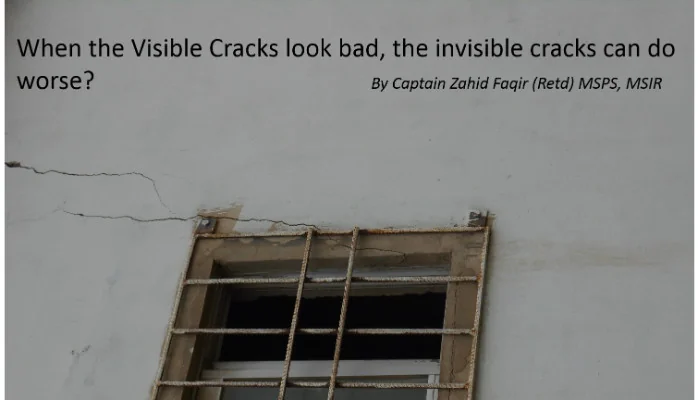
As a student of safety I have learnt for 25 years that safety accidents are more damaging when they happen because of invisible or should I say often ignored cracks, weaknesses and/or flaws in our HSE Management System.
For visible cracks we make everyone alert but when the earth quake comes houses fall at a angle directed by inner cracks, invisible cracks. Resultantly responses fail and surprises kill.
As soon as we observe a major violation, crack, unsafe practice, unsafe condition in HSE Management System and or some actual ground condition we must get to those issues and problems which are hidden under the visible display.
In the books of safety we call it RCA or Root Cause Analysis, in the books of Management its thread bear due diligence and in the books of accounts its thorough audit.
The Danger of Invisible Cracks
Visible cracks normally attract attention. Whether they appear in a building, a machine, a road or any other physical structure, people can see them and understand that something may be wrong. The real challenge, however, is dealing with cracks that cannot be easily seen.
In organizations, invisible cracks may exist in procedures, communication, supervision, training, maintenance practices and even in the attitudes of employees and management. Everything may appear normal on the surface, production may continue, targets may be achieved and no serious incident may have occurred. Yet, underneath this apparent stability, weaknesses may already be developing.
A near miss is often one of the earliest warning signs. Unfortunately, many organizations treat a near miss as good luck rather than an opportunity to learn. When an unsafe act or condition does not immediately result in an injury, people may assume that the risk was not serious. This thinking allows the same weakness to remain until circumstances change and the next event produces a more serious outcome.
The same principle applies to equipment and facilities. A small vibration, repeated leakage, unusual noise or minor failure may be ignored because operations can still continue. However, these may be early indicators of a developing problem. Effective inspection and preventive maintenance are therefore not merely technical activities; they are methods of identifying hidden weaknesses before they become visible failures.
Invisible cracks can also develop within teams. Poor communication between departments, unclear responsibilities, excessive workload, inadequate training and a fear of reporting problems can gradually weaken an organization. These issues may not appear in a routine inspection report, but they can directly influence safety performance and decision-making.
One of the most dangerous organizational attitudes is, “We have always done it this way and nothing has happened.” The absence of an accident does not necessarily mean that the system is safe. It may simply mean that the weaknesses have not yet aligned to create a serious event.
Organizations therefore need to develop the habit of looking beyond visible conditions. Employees should be encouraged to report unsafe conditions and near misses without fear. Supervisors should investigate recurring minor problems rather than waiting for a major incident. Management should also pay attention to weak signals coming from the workforce, maintenance records, inspection findings and operational disruptions.
A strong safety culture is not built by reacting only after visible damage appears. It is built by identifying and correcting the invisible cracks while there is still time. The earlier we recognize these weaknesses, the easier and less costly they are to repair.
In safety, as in life, what we cannot see may sometimes deserve even greater attention than what is already visible.
Whatever name we may give it we need to understand one important fact of life dressing the major crack cannot give us solutions. we must get to grass root levels.
If you wish to add on or comment, do it for improving the learnings
Do Share to Spread The Message if You Like
Have a question about this topic?
Get in Touch