
Safe Driving Practices
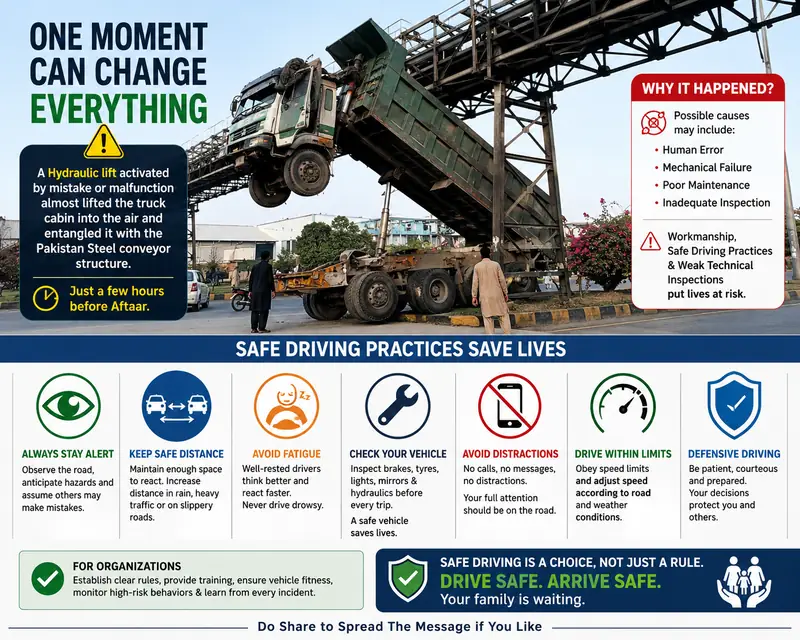
A week ago while I was coming back from my office I saw this incident live.
Either the driver pressed Hydraulic Lift Button by mistake while on move or it malfunctioned and was technically not fit enough to come on the road.
The Truck almost flew up in the air specially drivers cabin and entangled with the Pakistan Steel Conveyor Structure.
What a timing?
Just few hours before aftar.
Why Safe Driving Requires More Than Following Traffic Rules
Safe driving is often misunderstood as simply obeying traffic signals and avoiding over-speeding. While these are important, road safety depends on a much broader combination of driver behaviour, vehicle condition, road conditions, fatigue management and the ability to recognize hazards before they turn into an accident.
One of the most important principles of defensive driving is to assume that other road users may make mistakes. A vehicle may suddenly change lanes without indication, a motorcycle may appear in a blind spot, a pedestrian may cross unexpectedly, or the vehicle in front may stop suddenly. A safe driver continuously observes the road environment and maintains sufficient time and distance to react safely.
Maintaining a safe following distance is therefore essential. Driving too close to another vehicle reduces reaction time and significantly increases the possibility of a rear-end collision. The distance should be increased during rain, poor visibility, heavy traffic or whenever the road surface is slippery.
Driver fatigue is another major but frequently ignored risk. Long working hours, inadequate sleep and extended driving can reduce concentration and slow reaction time. Organizations that employ drivers should not focus only on vehicle availability and delivery schedules. They must also consider whether drivers are adequately rested and physically capable of performing their duties safely.
Vehicle condition is equally important. Brakes, tyres, lights, mirrors and steering systems should be inspected regularly. A skilled driver cannot fully compensate for a poorly maintained vehicle. Preventive maintenance and pre-use vehicle inspections should therefore be part of every organization’s road safety programme.
Distractions have also become a serious threat. Mobile phones, navigation systems, conversations and other distractions can take a driver’s attention away from the road for only a few seconds, but those seconds may be enough to cause a serious accident. No phone call or message is more important than arriving safely.
Organizations can further improve road safety by establishing clear safe-driving rules, conducting defensive-driving training, monitoring high-risk behaviours and learning from near misses as well as actual accidents. The objective should not be to blame drivers after an incident but to understand why unsafe conditions or behaviours were allowed to develop.
Ultimately, safe driving is a continuous decision-making process. Every journey involves changing conditions and unexpected hazards. The best drivers are not simply those who drive fast or confidently; they are those who remain alert, anticipate danger and consistently make decisions that protect themselves and everyone else sharing the road.
Detailed report must be very interesting but God Knows if it will be prepared or not.
Optically it seems Workmanship, Safe Driving Practices and Weak Technical Inspections.
If you wish to add on or comment, do it for improving the learnings
Do Share to Spread The Message if You Like
Have a question about this topic?
Get in Touch